Intro
The first Christmas in my apartment, I bought a tree the way I had always bought trees: I walked into the lot, pointed at the tallest one I could afford, and dragged it home. It took me about four minutes to realise my mistake. The tree filled the only clear corner of the living room, blocked half the window, and turned the walk from the sofa to the kitchen into a sideways shuffle past a wall of branches. By Boxing Day I was decorating around it like it was a piece of furniture I had tripped over, and I promised myself I would never do that again.
The problem was not the tree. It was the assumption that a Christmas tree needs a big empty patch of floor. In a small apartment, floor space is the most expensive thing you own, and a traditional tree spends all of it at once. But a small apartment christmas tree does not have to mean a sad little twig on a shelf, either. There is a whole middle ground between a full-size tree and no tree at all, and most of it comes down to one question: where in this room is there space that nobody is actually using?
That is the question this guide answers. I have tried nearly every version of it over the years — the corner tree, the tabletop tree, the tree that hangs on the wall, the one that lives on the windowsill — and I have learned which ones actually feel like Christmas and which ones just feel like a compromise you resent by the second week of December. Here are the seven spots that work.
1. Start With the Corner Nobody Uses
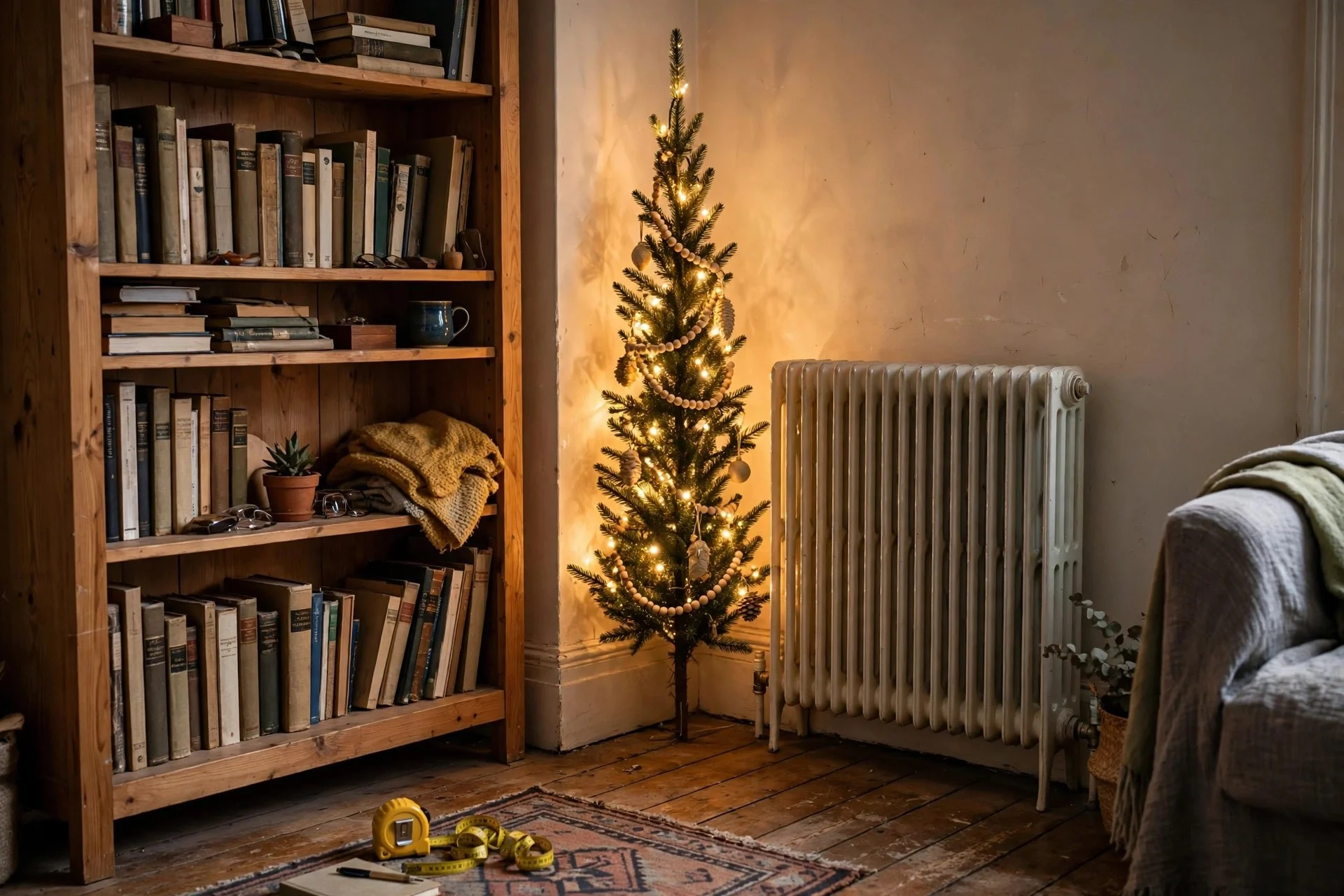
Every apartment has at least one dead corner. The one behind the door that never quite opens all the way. The gap between the bookcase and the wall. The triangle of floor beside the radiator that is too awkward for furniture and too small for anything but a pile of things you meant to deal with. That corner is your tree’s first and best home, because it costs you nothing you were using.
Measure it before you buy anything. Stand in the corner with a tape measure and check the width at the widest point of the branches, not just the trunk. A tree that is thirty inches across at its base needs a corner at least that wide, plus a few inches of breathing room so the branches are not crushed flat against the wall. And measure the height to the ceiling, then subtract a foot, because a tree that brushes the ceiling looks cramped instead of cosy, and you still need room for a topper.
Then pick the tree for the corner, not the other way round — choosing the right spot first is half the job. A slim or pencil tree is built for exactly this spot: tall, narrow, and shaped so it tucks into a corner without swallowing the room. A half tree, flat on one side, is even better, because the flat side sits flush against the wall and the full side faces the room. If you are still deciding between a tall skinny tree and a wide one, the tricks that make a skinny tree look full are worth knowing before you spend the money. Put the tree in the corner first, step back, and live with it undecorated for an evening. If you can walk past it without turning sideways, you have found your spot.
2. Go Skinny, Go Tall, or Go Half
If the corner test fails — if even the dead corners are spoken for — the tree itself has to change shape. This is where most small-apartment trees go wrong, because people buy a smaller version of a big tree instead of a different kind of tree. A four-foot tree that is still three feet wide takes up nearly as much floor as a full-size one, and it looks like a tree that gave up halfway. The shape matters more than the height.
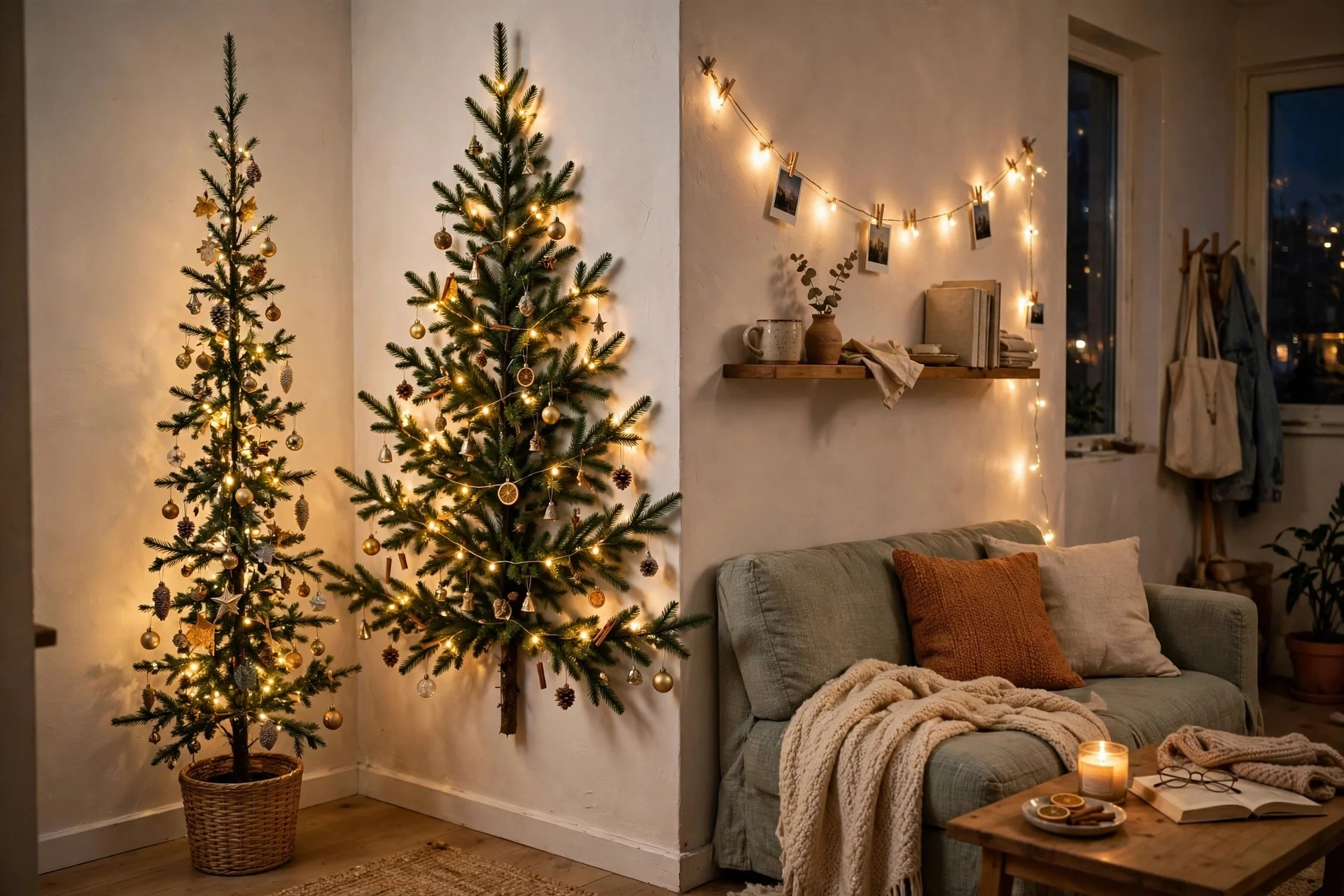
A pencil tree, sometimes sold as a slim or narrow tree, is usually only eighteen to twenty-four inches across at its widest point. That is less floor than a laundry basket. It still reaches six or seven feet tall, so it still reads as a proper Christmas tree from across the room, and it still holds plenty of ornaments, just in a vertical line rather than a wide cone. A half tree goes further: it is a full tree cut in half down the middle, flat against the wall, so it sticks out about half as far into the room. It looks complete from the front, which is the only angle anyone ever sees in a small living room.
Then there is the upside-down tree, which sounds like a joke until you see one in a small room. It hangs from the ceiling or stands on a narrow base with the wide end at the top, which means the widest part of the tree is up near the ceiling, where nobody walks, and the narrow end is down at floor level. I have not tried one myself, but a friend in a studio swears by it, and the logic is hard to argue with: the floor space it uses is roughly the size of a dinner plate. Whatever shape you choose, decide on it before you buy the ornaments, because a pencil tree needs fewer, smaller baubles than a wide one, and the wrong scale is what makes a small tree look sparse.
3. The Tabletop Tree Is Not a Compromise

I used to think a tabletop tree was what you bought when you had given up on a real one. Then I spent one December with a three-foot tree on the sideboard, and it changed my mind completely, because a tabletop tree sits at eye level, which is where you actually look. A full-size tree’s best ornaments are always the ones at eye height anyway; the top is for the ceiling and the bottom is for the dog. A tabletop tree puts all of its best work right where you can see it.
The trick is to treat it like a real tree, not a decoration you bought at the last minute. Put it on a piece of furniture that already belongs in the room — a sideboard, a console table, the top of a low bookcase, a sturdy plant stand — and give it a proper base. A real tree skirt is too big, so use a folded throw, a linen napkin, or a round placemat, and tuck a string of lights around the base so the whole thing glows from underneath. Then decorate it exactly as you would a big tree: lights first, then garland or ribbon, then ornaments from large to small, then a topper. A three-foot tree holds about thirty ornaments comfortably, which is enough to look generous without looking crowded.
The one thing a tabletop tree cannot do is hold the presents underneath, so plan for that. I keep a basket beside the sideboard for wrapped gifts, which looks intentional and keeps the floor clear, and it also stops anyone from stacking boxes against the tree and knocking it over. And keep it away from the edge of the furniture by at least a hand’s width, because a tabletop tree that falls is a tabletop tree that loses half its ornaments, and I learned that one the expensive way.
4. Hang It on the Wall (Yes, Really)

This is the option that sounds strange until you see it done well, and then it looks like the most obvious idea in the world. A wall tree takes up zero floor space, which in a small apartment is the entire argument. You build the shape of a tree on the wall — with branches, with garland, with lights, or even with a flat felt tree — and you decorate it the same way you would a standing one. From across the room, with the lights on, it reads as a tree. Up close, it reads as something clever, which is honestly a better compliment.
The simplest version is a string-light tree. Map out a triangle on the wall with removable hooks, run a string of warm white lights along the outline, and add a few more strands zigzagging across the middle, then hang lightweight ornaments from the hooks and the light strands. The whole thing comes down in January with no holes and no damage, which is the part your landlord will care about. The more elaborate version uses real evergreen branches wired to a frame or pinned to the wall in a triangle, which smells wonderful and looks astonishingly like a tree from the sofa, though it does need fresh branches and a bit more patience.
Either way, the rules are the same. Keep the tree at eye level and above, so it does not fight with the sofa or the radiator. Use lightweight ornaments only — felt, paper, wood, or plastic — because anything heavy will pull the hooks off the wall. And put a small basket or a few wrapped boxes on the floor underneath it, because a tree with nothing at its base looks like it is floating, and a couple of presents anchor it the way a tree skirt anchors a standing tree. I was sceptical about wall trees until I saw one in a friend’s hallway, and I have to admit it looked better than my corner tree did that year.
5. Borrow the Window — But Keep the Walkway Clear
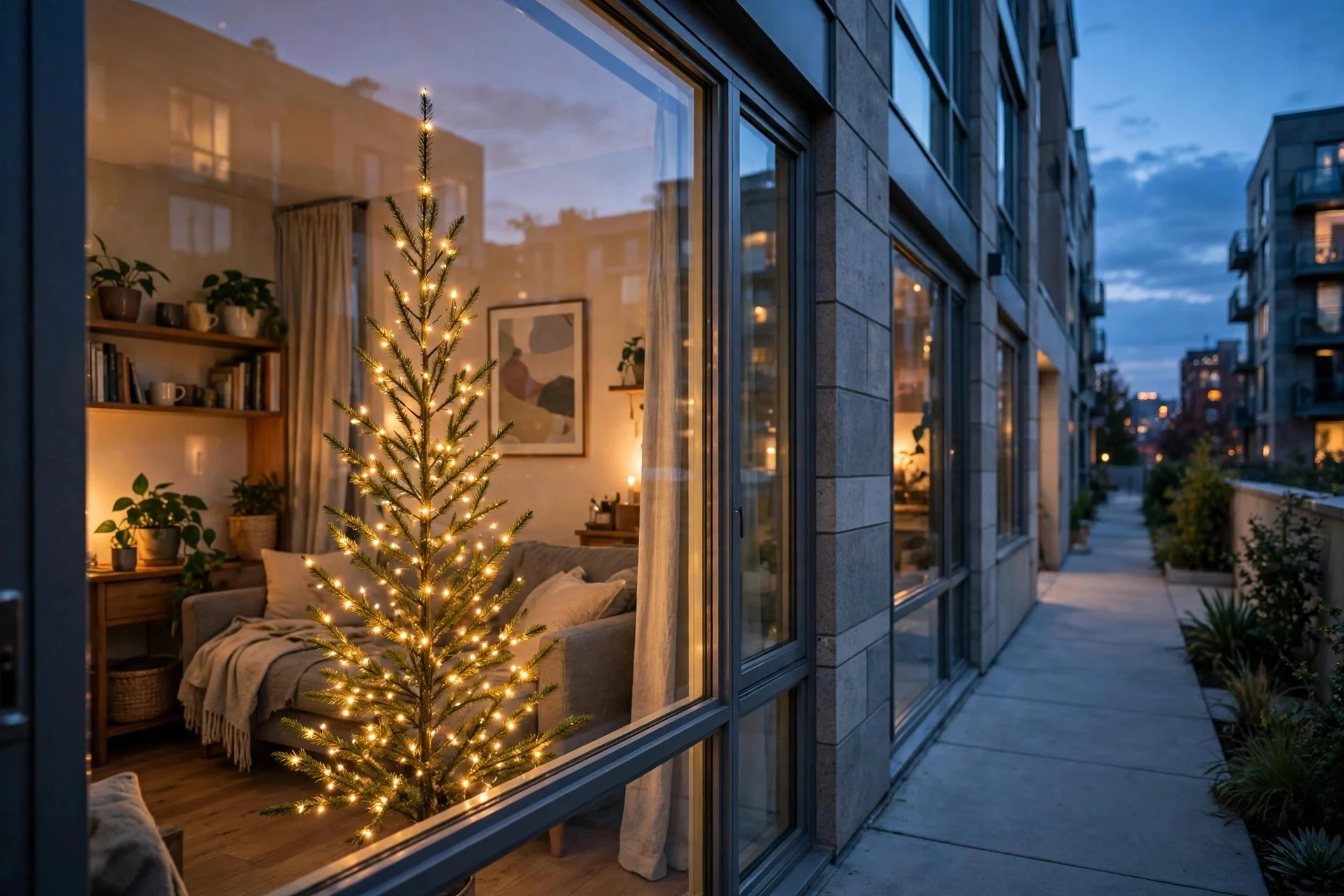
A window is the one spot in a small apartment where a tree does double duty: it looks good from inside, and it looks good from the street, which is free Christmas spirit for the whole building. A tree in front of a window catches the light during the day and glows from behind when the fairy lights come on at dusk, and it never blocks anything you need, because nobody walks through a window.
The catch is the walkway. A tree in front of a window usually sits in the path between the sofa and the door, or between the kitchen and the table, and that is where small apartments punish you. So before you commit, stand where the tree would go and walk the route you actually use every day — to the kitchen, to the bathroom, to the front door — and make sure you can do it without turning sideways or brushing the branches. If you cannot, the window is not your spot, no matter how pretty it looks in your head.
If the walkway is clear, the window tree is genuinely lovely, and it works best with a slim or half tree so the glass stays visible and the light still comes through. Keep the tree a few inches back from the glass so condensation does not soak the branches, and if your windows are old and draughty, keep real candles far away and stick to battery lights, which is good advice anywhere but doubly so next to a curtain. A small tree on the windowsill itself is the other version of this idea, and it works beautifully in a kitchen or a bedroom where the sill is deep enough to hold a two-foot tree without it toppling into the sink. And if the window looks out onto a porch, the tree inside can echo the decorations outside, which is one display doing the work of two.
6. Let Furniture You Already Own Hold the Tree

The cheapest way to fit a tree into a small apartment is to stop thinking of it as a thing that needs its own patch of floor, and start thinking of it as a thing that can live on top of something you already have. The furniture is already there. The floor space under it is already spoken for. The top of it is usually empty, or holding a plant that could move for a month.
A low bookcase is my favourite version of this. A three- or four-foot tree on top of a bookcase sits at the perfect height, the books underneath become part of the display, and the whole thing looks like you planned it, because the tree and the furniture are roughly the same width. A dresser in the bedroom works the same way, and it has the added benefit of being the first thing you see in the morning. A bar cart, a plant stand, or a sturdy side table all do the same job, and a tree on wheels is worth considering too: a small tree on a rolling plant caddy can be pushed into a corner during the day and pulled out into the room in the evening.
Whichever piece you choose, check two things before the tree goes on it. First, that the furniture can hold the weight, because a potted tree with a wet root ball is heavier than it looks, and a bowed shelf in January is a worse problem than no tree at all. Second, that the surface is level and the tree cannot slide, because a tree on top of furniture is a tree at head height. A non-slip mat under the pot or the tree stand costs almost nothing and saves the furniture and the ornaments in one go. And keep the tree away from radiators and heat vents, because dry heat is what makes a real tree drop its needles in a week.
7. Anchor It Like a Renter (No Drilling, No Damage)

Here is the part that matters most in a rental, and the part most Christmas guides skip entirely: a tree in a small apartment falls over more easily than a tree in a big house, because it is always within arm’s reach of a door, a dog, a child, or a clumsy housemate carrying a laundry basket. And a tree that falls in a rental is not just a mess. It is a scratched floor, a dented wall, and a conversation with your landlord that nobody wants to have in January.
So anchor it like you mean it, and do it without a single hole in the wall. A heavy, wide tree stand is the first line of defence, and it is worth spending a little more on one than the flimsy plastic stand that comes free with the tree, because the stand is doing all the work. Fill the stand with water for a real tree, which adds weight, and put a non-slip mat or a rug gripper underneath it so it cannot slide on hard floors. Then add a second anchor: a length of fishing line or clear cord from the top third of the tree to a removable adhesive hook on the wall behind it. The line is invisible from the front, the hook peels off in January without a mark, and the tree cannot tip forward, which is the direction trees always fall.
The same no-damage thinking applies to everything around the tree. Use adhesive hooks for the lights, not nails or staples. Use removable putty for the garland, not screws. Keep the tree away from the door’s swing, because a door that catches a branch every time it opens will eventually pull the tree down. I learned most of this the year my tree went over on a Tuesday night and took a picture frame with it, and the damage was small but the lesson stuck: in a rental, the tree that stays upright is the tree you can actually enjoy.
Closer
A small apartment does not need a small Christmas. It needs a Christmas that fits the room it is actually in, and that is a design problem, not a sacrifice. The tree that lives in a dead corner, or on top of the bookcase, or flat against the wall, is not a lesser tree. It is a tree that was chosen for the space, and that choice is what makes it look good instead of looking like a tree that lost an argument with the floor plan. That is what a small apartment christmas tree is really about: choosing for the space you have, not mourning the space you do not.
If you are still working out the rest of the room, it is worth reading about the mistakes that trip most people up before you buy anything else, because the tree is only the beginning, and the same small-space thinking that finds it a home will find a home for everything else too.