Every Thanksgiving I used to do the same thing. The week before, I would stand in front of an empty table with a box of decorations I had collected over the years and absolutely no plan. I would pull out a little of everything — a glittery pumpkin here, a plaid runner there, a candle that smelled like a bakery exploded — until the table looked busy instead of beautiful. Guests complimented it politely, and I knew it looked like a craft store had sneezed on my dining room.
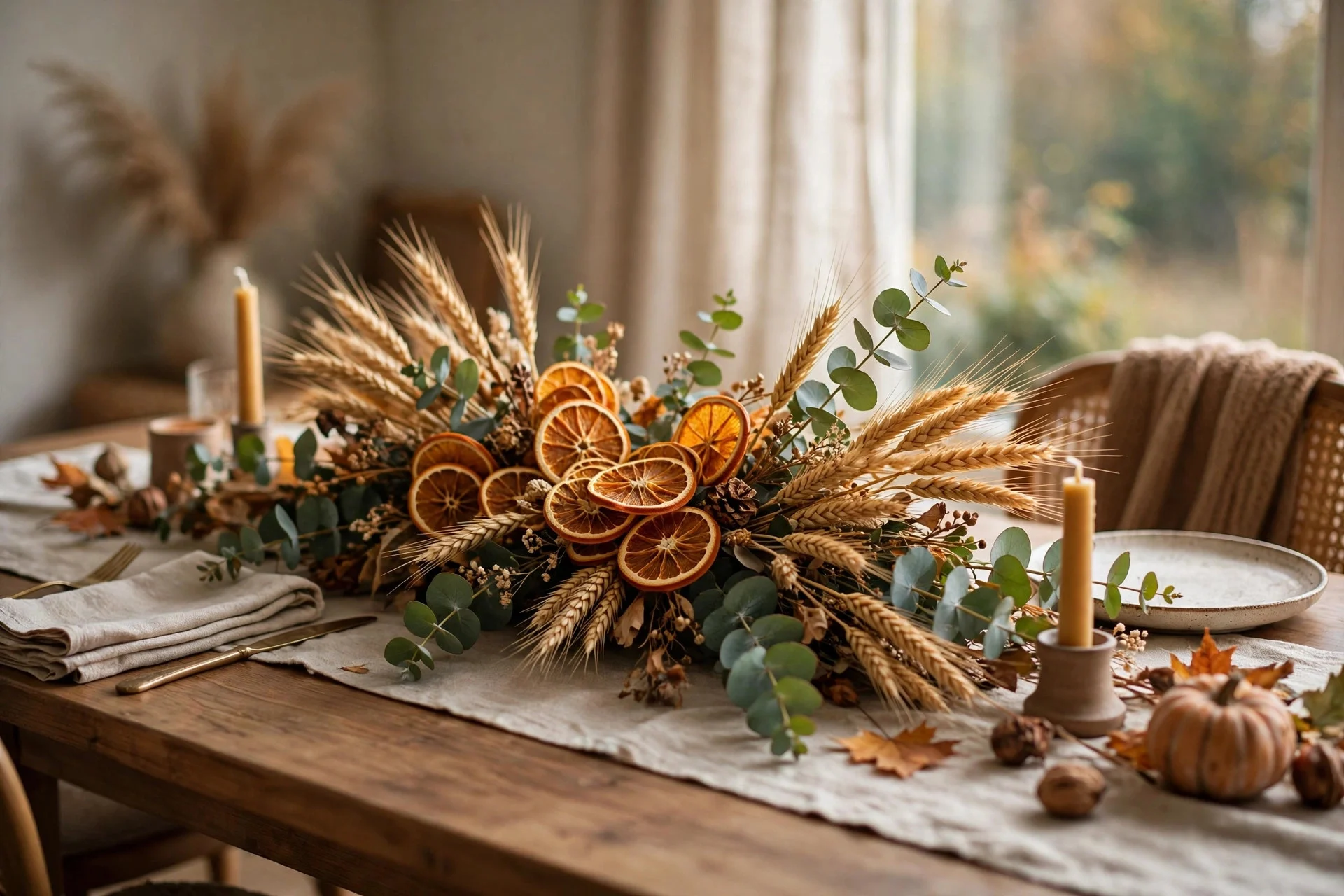
Then three years ago, a friend came over early to help me set the table, took one look at the chaos, and quietly cleared everything off. She came back with a bowl of dried orange slices, a bunch of wheat from the farmers market, and a few sprigs of eucalyptus. She laid them down the middle of the table in about four minutes. That was it. No runner, no candles, no figurines. The whole room changed: it smelled faintly of oranges and fresh green leaves, the gold of the wheat caught the light, and the table suddenly looked like it belonged in a magazine — for almost nothing.
That was the year I stopped over-decorating Thanksgiving. Since then, this little trio has become my whole approach to natural thanksgiving decor. Dried orange slices, wheat, and eucalyptus — three things, three jobs, one formula. The oranges bring the warmth and the colour, the wheat brings the height and the harvest feeling, and the eucalyptus brings the softness, the green, and that clean, fresh smell. Nothing else is required, and honestly, the less you add, the better it works.
If Thanksgiving decorating has ever overwhelmed you, or you are working with a tight budget this year, this is the formula for you. Below I will walk you through each element, then show you how to put the three together and where in the house the combination works best. If you are decorating on a budget overall, my guide to Thanksgiving table decor that costs almost nothing pairs well with this one, because most of what follows costs less than a single store-bought centrepiece.
Dried Orange Slices: The Warmth
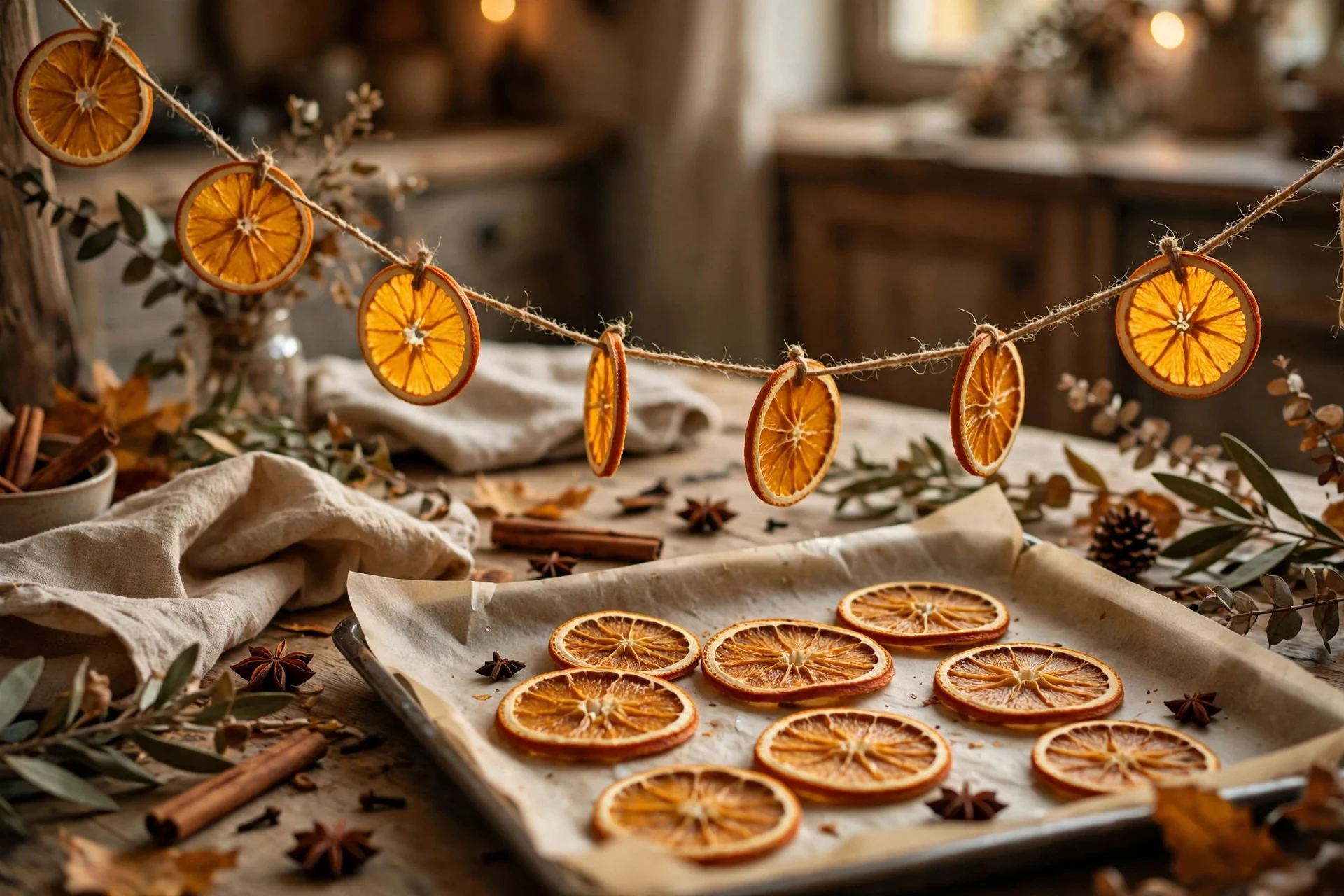
Let me start with the element that does the most work for the least money: dried orange slices. A bag of oranges costs a few dollars, and one batch gives you enough slices to decorate the table, the mantel, and the entryway with plenty left over. Dried properly, they turn a deep amber colour, almost like stained glass, and they catch the light in a way that makes everything around them look warmer. They also smell wonderful while they dry.
Here is the method I have settled on after a few years of trial and error. Slice your oranges as thin as you can, about a quarter of an inch, and pat them dry with a kitchen towel. Lay them in a single layer on a baking tray lined with parchment paper. Put the oven on its lowest setting — around 200 degrees — and bake them for two to three hours, flipping them once halfway through. They are done when they feel dry and slightly stiff, with no soft, wet spots in the middle. Let them cool completely on the tray before you touch them, because they firm up as they cool.
Now, the mistake I made the very first time: I got impatient, turned the oven up to 300 degrees to speed things along, and ended up with orange slices that were brown, curled into little cups, and smelled faintly of burnt toast. Learn from me — low and slow is the whole secret. If your oven runs hot, prop the door open a crack with a wooden spoon. You can also buy dried orange slices ready-made at craft stores or online, but the homemade ones look better and cost a fraction of the price.
Once your slices are ready, you have options. Scatter a few loose ones down the centre of the table, tuck them into the eucalyptus so they peek out, or thread them onto twine with a needle to make a simple garland for the mantel. One word of caution: keep them away from open flames. They are dried fruit, and they will catch if a candle tips into them — one more reason I prefer this formula without candles crowding the centrepiece.
Wheat: The Height
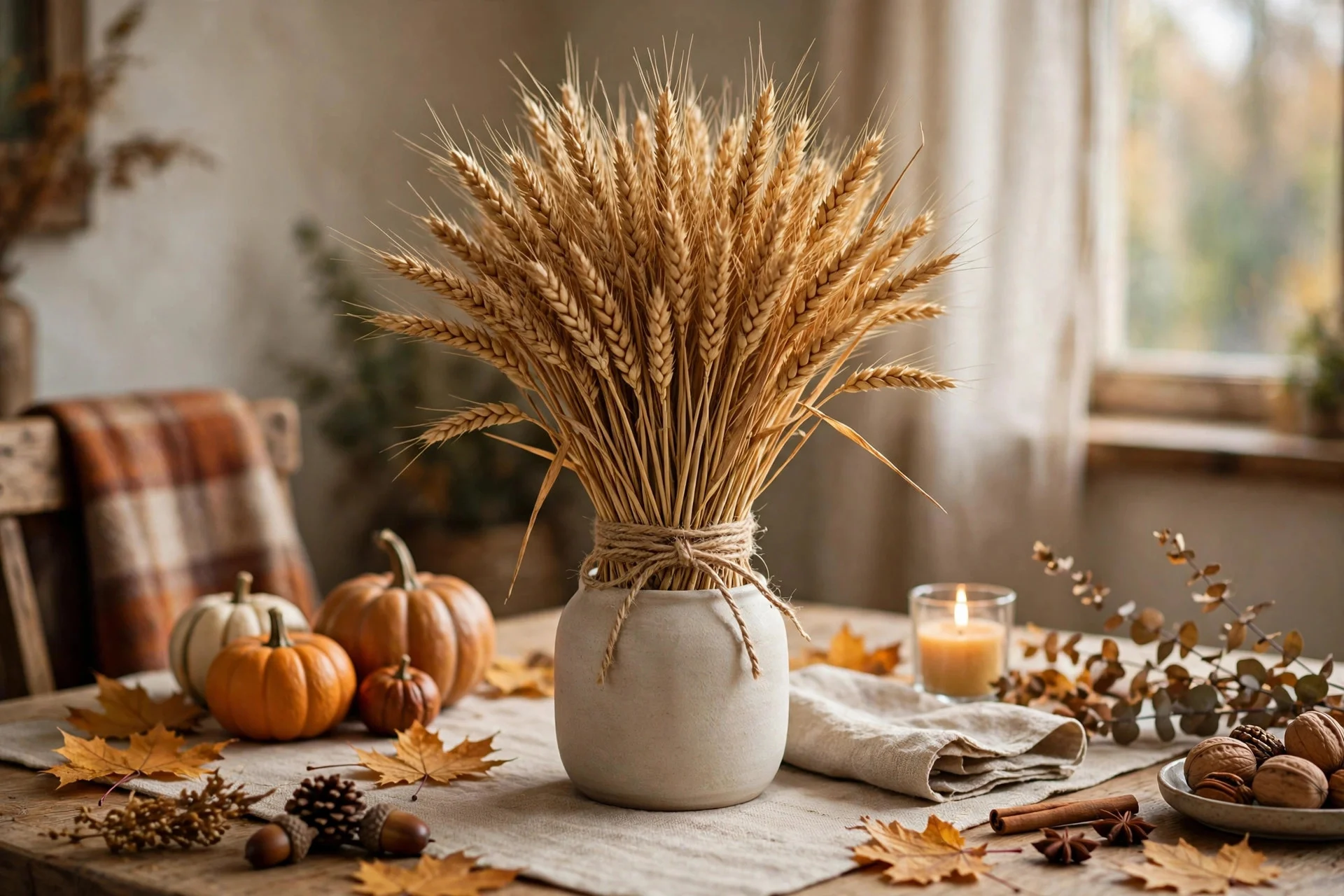
If the orange slices are the warmth, wheat is the height. Every centrepiece needs something that lifts the eye upward, or the whole table feels flat, like everything is lying down. Wheat does that job beautifully, with a golden, harvest feeling that no other material quite matches. It is also the most forgiving of the three elements. You cannot really arrange wheat wrong — in a vase, in a flat bundle, or leaning against a candlestick, it always looks intentional.
Where do you actually buy wheat? In late October and early November, most farmers markets sell small bundles of dried wheat for a few dollars. Craft stores carry it in the floral section all autumn, usually in the same aisle as the dried flowers. If you have a florist nearby, ask them — many keep wheat in stock during the fall season, and they will often sell you a bunch for less than the craft store charges. Online, you can buy a larger bundle and split it between the table, the mantel, and the front door.
A few practical notes from someone who has spilled wheat all over a dining room floor more than once. First, buy more than you think you need, because a thin, stingy bunch looks sad, while a full, generous bundle looks abundant. Second, tie your bundle with twine before you put it in the vase, or the stalks will slowly splay outward and flop over the rim. Third, keep the vase low and heavy. Wheat is top-heavy, and a tall, narrow vase on a table full of elbows and passing dishes is an accident waiting to happen. I use a short ceramic pitcher or a wide mason jar.
Eucalyptus: The Smell and the Softness
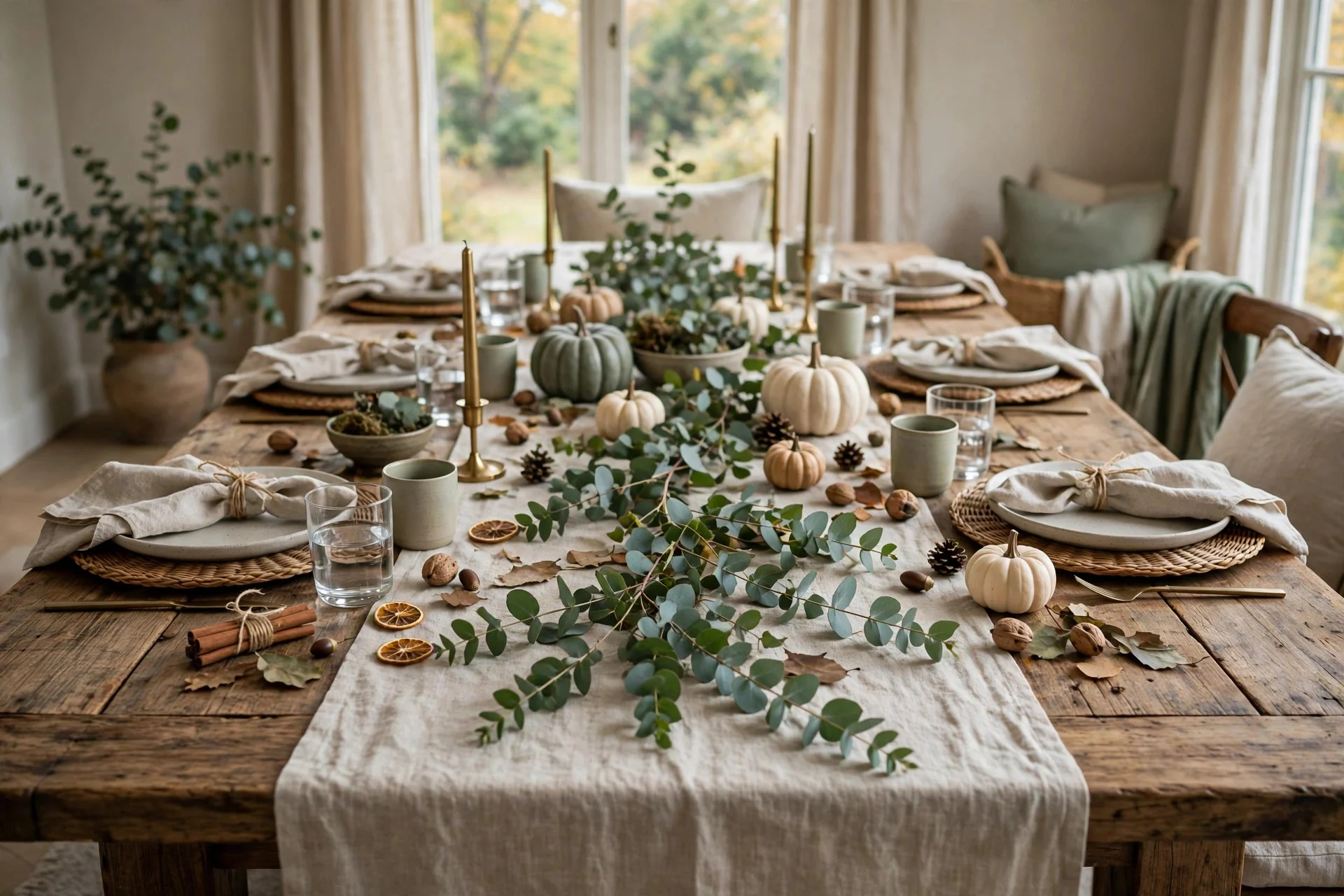
That leaves the eucalyptus, which is my favourite of the three — and the one people always ask about. Eucalyptus is the softness in the formula. The oranges are round and bright, the wheat is tall and golden, and without something green and loose to tie them together, the arrangement can feel stiff, like two ingredients sitting next to each other instead of one composition. Eucalyptus drapes and spills, softening every hard edge on the table, and it brings a fresh, clean scent that cuts through the richness of a Thanksgiving kitchen.
The question everyone asks is fresh or dried, and the honest answer is that both work, but they do different jobs. Fresh eucalyptus is softer, greener, and more fragrant. It looks lush the day you buy it, and it is perfect for the table, where people will smell it as they sit down. The trade-off is that it starts to dry out after a few days, so buy it no more than two or three days before Thanksgiving. Dried eucalyptus is stiffer and more muted in colour — a soft, silvery green — and its scent is fainter. But it lasts for weeks, holds its shape, and suits the mantel or entryway, where it must look good all season.
Where to find it? Most grocery stores with a decent floral section carry small bunches of fresh eucalyptus in the fall, usually for just a few dollars. Florists always have it, and farmers markets often do too. If you can only find dried, do not worry — it still works beautifully. I usually buy one fresh bunch for the table and one dried bunch for the mantel, and that covers the whole house.
One thing worth knowing: eucalyptus drops small leaves as it dries, especially the fresh kind. It is not a disaster — a quick sweep before guests arrive takes care of it — but do not lay it directly on a white tablecloth you care about. A runner or a strip of brown kraft paper underneath solves the problem and adds to the rustic look. And if you have a cat, keep the eucalyptus out of reach, because the leaves are not something pets should chew on.
The Formula: How to Combine All Three
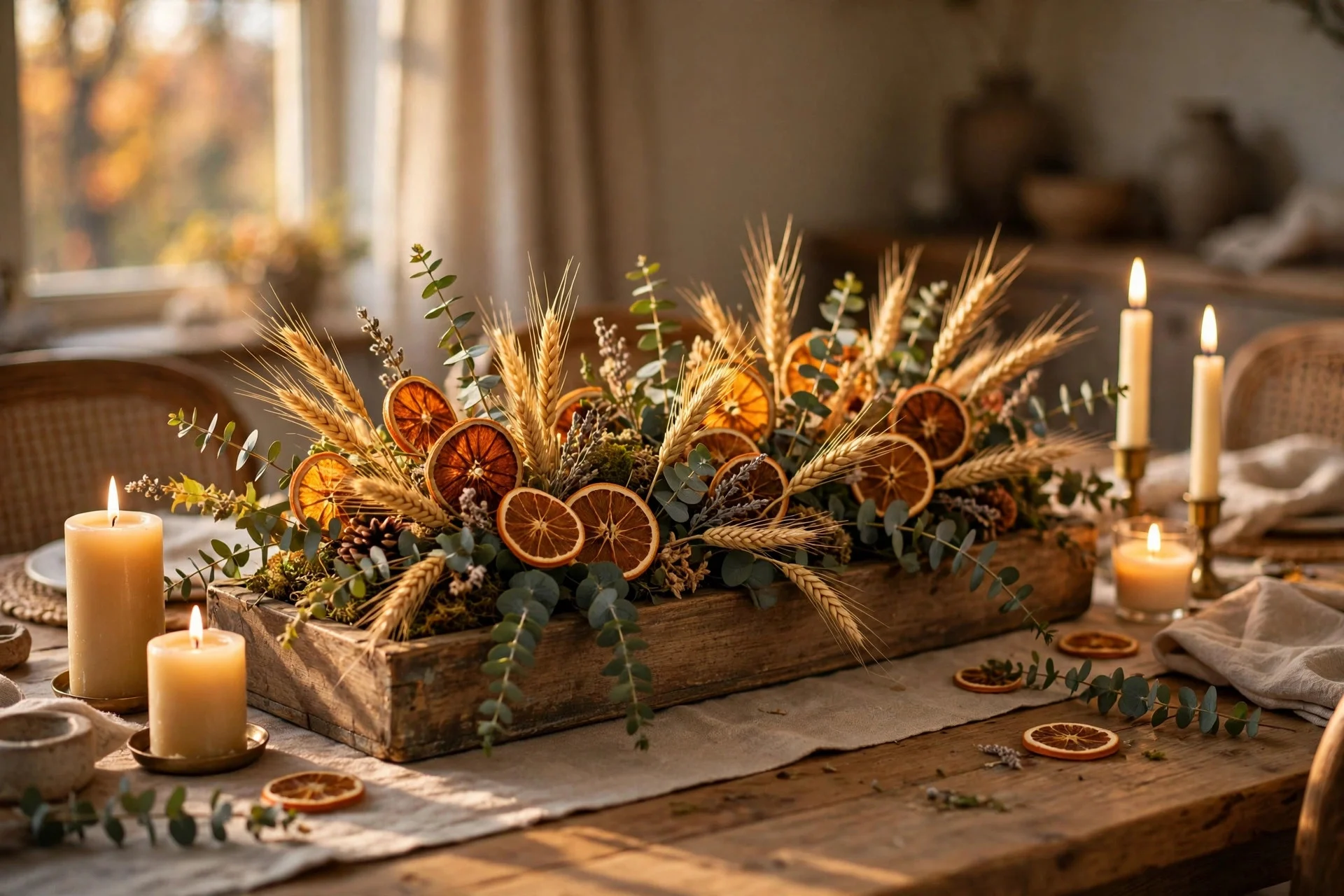
Here is where the three elements stop being three separate decorations and become one formula. The proportions matter more than any single ingredient, and the ratio is easy to remember: roughly half eucalyptus, a third wheat, and a handful of orange slices. Think of the eucalyptus as the base layer, the wheat as the structure, and the orange slices as the jewellery — the little pops of colour that catch the eye. Getting this balance right is what makes the whole natural thanksgiving decor formula feel calm instead of cluttered.
Start with the eucalyptus. Lay the sprigs down the centre of the table in a loose, overlapping line, letting the ends spill a little past where the centrepiece will sit. Eucalyptus looks best slightly wild, like it grew there. On a mantel or a console, drape it along the edge and let a few sprigs hang down. That soft, trailing line is what makes the whole thing feel relaxed rather than staged.
Next, the wheat. Stand a small bundle in a low vase at the centre, or if you want a lower, flatter look, lay two or three stalks flat along the eucalyptus, crossing them slightly so they feel woven in rather than placed on top. One bundle is enough for a table that seats six to eight people. The wheat should be the tallest thing on the table, but not by much — this is a centrepiece people need to see over, not a hedge.
Finally, the orange slices. Tuck them into the eucalyptus at intervals, maybe one every foot or so, and lean one or two against the base of the wheat vase. Do not scatter them evenly like confetti — group them in twos and threes, because clusters look intentional and singles look like accidents. Step back and look from the doorway: if your eye jumps straight to the oranges, you have too many; if you have to search for them, add two more.
If you want a faster version for a busy year, there are plenty of Thanksgiving centrepieces you can make in under an hour, and this formula fits right in — once the oranges are dried, the whole assembly takes about ten minutes. And if you are wondering how this palette sits with the rest of your autumn colours, it is worth a quick look at which colour scheme works best for Thanksgiving — these three elements pair best with creams, soft browns, and muted greens.
Where to Use It: Table, Mantel, and Entryway
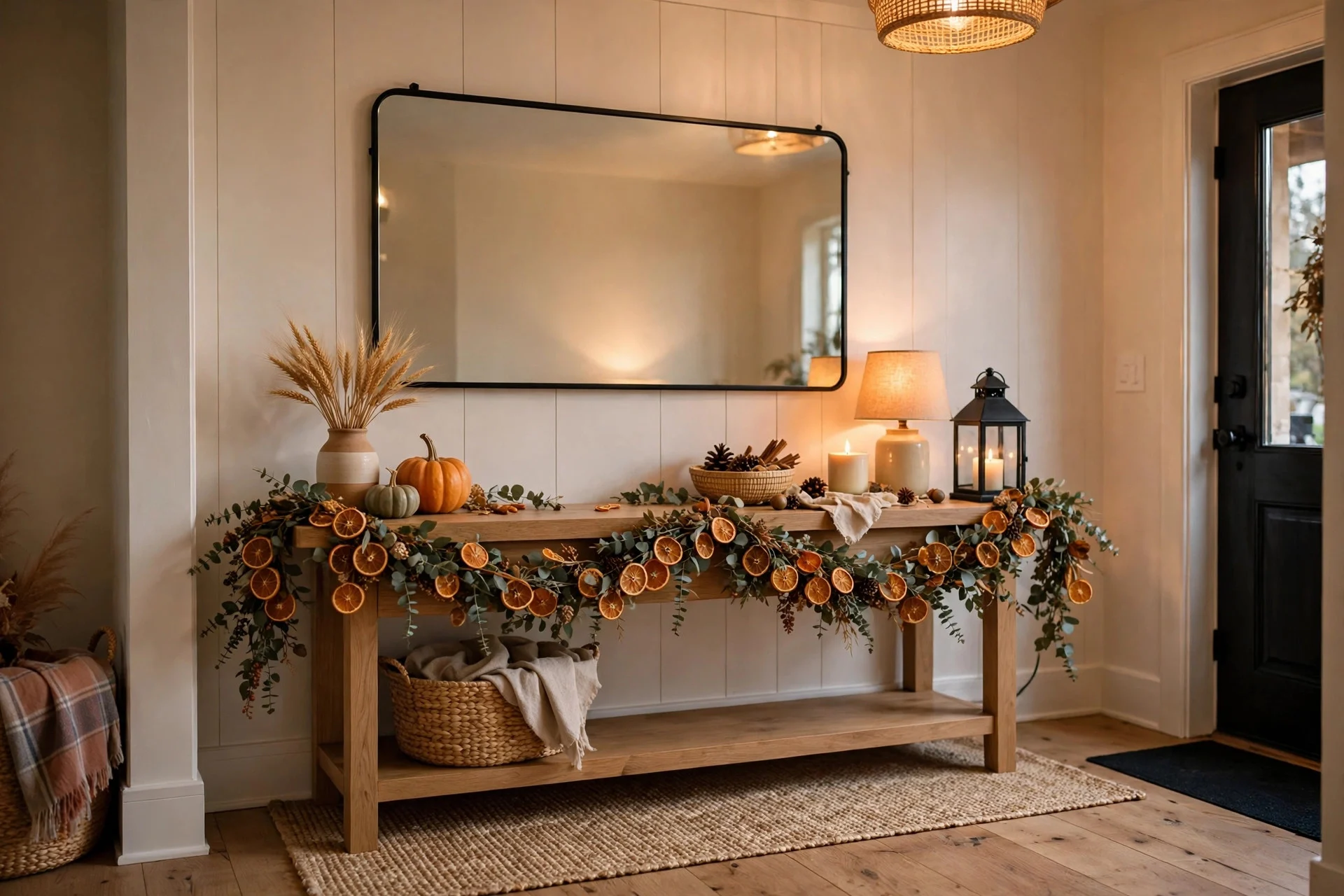
The best thing about this formula is that it is not a one-table trick. The same three elements work in three different places in the house, and once you have the ingredients, it costs nothing extra to use them everywhere.
The table is the obvious one, and it is where the formula shines brightest, because that is where people gather, eat, and actually look at the decorations for hours. Keep it low. A centrepiece that blocks the view across the table kills conversation, and Thanksgiving is a day for conversation. The eucalyptus lies flat, the oranges tuck in low, and the wheat is the only thing with height — and even that should stay below eye level when you are seated.
The mantel is the second spot, and it is where the formula gets to be a little more dramatic. Here you can let the eucalyptus trail down the sides, hang the orange-slice garland across the front, and stand a taller bundle of wheat in a vase at one end. Because nobody eats at the mantel, you can go bigger and looser here — height is a feature, not a problem.
Then there is the entryway, which is the spot most people forget and the one your guests actually see first. A small console or side table by the front door, with a vase of wheat, a few sprigs of eucalyptus, and three or four orange slices tucked in, takes about three minutes and sets the tone for the whole evening.
The Mistakes I Made So You Don’t Have To
I have made just about every mistake this formula allows, so let me save you the trouble. First, do not over-buy. The first year, I came home with three bunches of eucalyptus, two bags of oranges, and enough wheat to thatch a roof. One bunch of eucalyptus, one bag of oranges, and one bundle of wheat covers a table, a mantel, and an entryway with room to spare.
Second, do not build the table arrangement the night before with fresh eucalyptus and then wonder why it looks tired by dinner. Fresh eucalyptus is a two-to-three-day ingredient. Build the mantel and the entryway early in the week with dried eucalyptus, and save the fresh bunch for the table on the morning of Thanksgiving. It takes ten minutes.
Third, resist the urge to add a fourth element. I have tried pinecones, miniature pumpkins, fairy lights, a plaid runner — and every single time, the table looked worse, not better. The formula works because it is restrained. Three textures, three colours, three jobs. The moment you add a fourth thing, the calm, gathered feeling disappears.
And last, do not forget the rest of the house. The table is the star, but a bare mantel and an empty entryway make the decorated table feel like a stage set rather than a home. Now I split the ingredients three ways before I start, and the whole house feels like Thanksgiving, not just one room.
That is the whole formula: dried orange slices for warmth, wheat for height, eucalyptus for softness and scent, combined in roughly the right proportions and repeated in the three places your guests will actually see. It is cheap, simple, and smells wonderful. Try it once this Thanksgiving, and I think you will find — the way I did, standing in my living room three years ago — that the simplest table is the one everyone remembers.