Two years ago, I decorated for Thanksgiving on November 1st. I was so pleased with myself. The porch was done, the mantel was done, the table was set — a full three weeks early, and I remember standing in the living room thinking I had finally cracked the code on a calm holiday. Then the pumpkins on the porch went soft, then mushy, then genuinely embarrassing. The eucalyptus dried out and started shedding every time someone walked past it. And by the time Thanksgiving actually arrived, the house didn’t feel festive anymore. It felt tired, like decorations that had been sitting out too long — because they had.
The next year I swung too far the other way and did everything the night before. I was up until 1 a.m. wrestling with a garland that kept sliding off the mantel, and I woke up on Thanksgiving morning already exhausted, with flour on my shirt and a house that looked like it had been decorated by someone in a hurry — because it had.
Both years taught me the same lesson: the question isn’t really when to decorate for thanksgiving as one big event. It’s when to decorate each room, because every room has its own clock. The porch can go up weeks early. The table should wait until the last minute. Once I stopped treating the whole house as one job and started working room by room, Thanksgiving week finally felt calm. If you’re still switching over from Halloween, my guide to the fastest way to switch to Thanksgiving decor will get the spooky stuff out of the way first — then this timeline tells you what to put up, and when.
The Short Answer: Two Waves, Not One Big Day
If you want the whole plan in one paragraph, here it is. Decorate in two waves. Wave one, in the first week of November, covers the outside of the house and the rooms people see but don’t live in: the porch, the entryway, and the first layer of the living room. Wave two, in the final week, covers the rooms where the holiday actually happens: the dining room, the kitchen, and the table itself. Everything that is fresh — real pumpkins, cut greenery, flowers, food — goes up in wave two, or even on the day itself.
The reason this works is simple: hardy decor lasts, and fresh decor doesn’t. A wreath can hang for a month and look the same. A real pumpkin cannot. A stack of throw pillows doesn’t care how early you put it out. A bowl of clementines does. So the timeline below isn’t about rules for the sake of rules — it’s about matching each room to what its decorations can actually survive.
One more thing before we go room by room: you don’t have to decorate every room. If your Thanksgiving lives in the dining room and the kitchen, decorate those two properly and let the bedrooms be. Nobody has ever remembered a Thanksgiving fondly because the guest bedroom had a pumpkin in it.
Week One (November 1–7): Porch and Entryway First
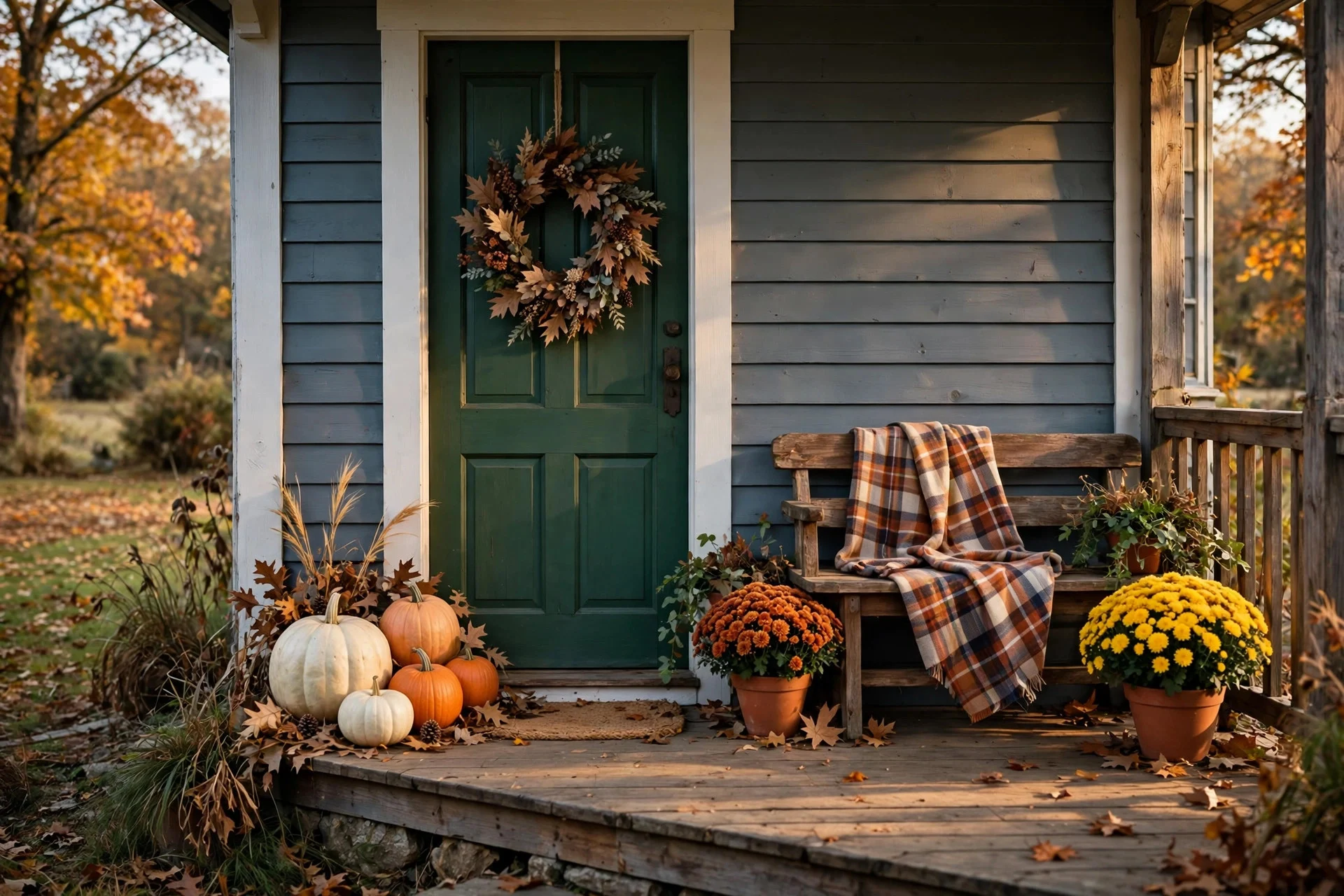
The porch is always first, for two reasons. It’s the part of the house that sets the tone before anyone steps inside, and it’s also the part that can handle the weather and the wait. The first week of November is the sweet spot: Halloween is over, the neighbours have taken their skeletons down, and a fall porch still looks right for a solid three weeks.
Here’s how I do it. First, I clear everything Halloween off the porch — the fake webs, the plastic bats, all of it — and give the door a proper wipe-down, because nothing ruins a fall wreath faster than a dusty door. Second, I put out the hardy stuff: a wreath of dried leaves, a couple of pumpkins in cream and muted orange (never the bright orange jack-o’-lantern pumpkins, which are already past their best by now), and a pot of mums if the garden centre still has them. Third, I add one soft thing — a plaid throw folded over the bench, or a doormat in a warm colour — because a porch with nothing soft on it looks like a shop display.
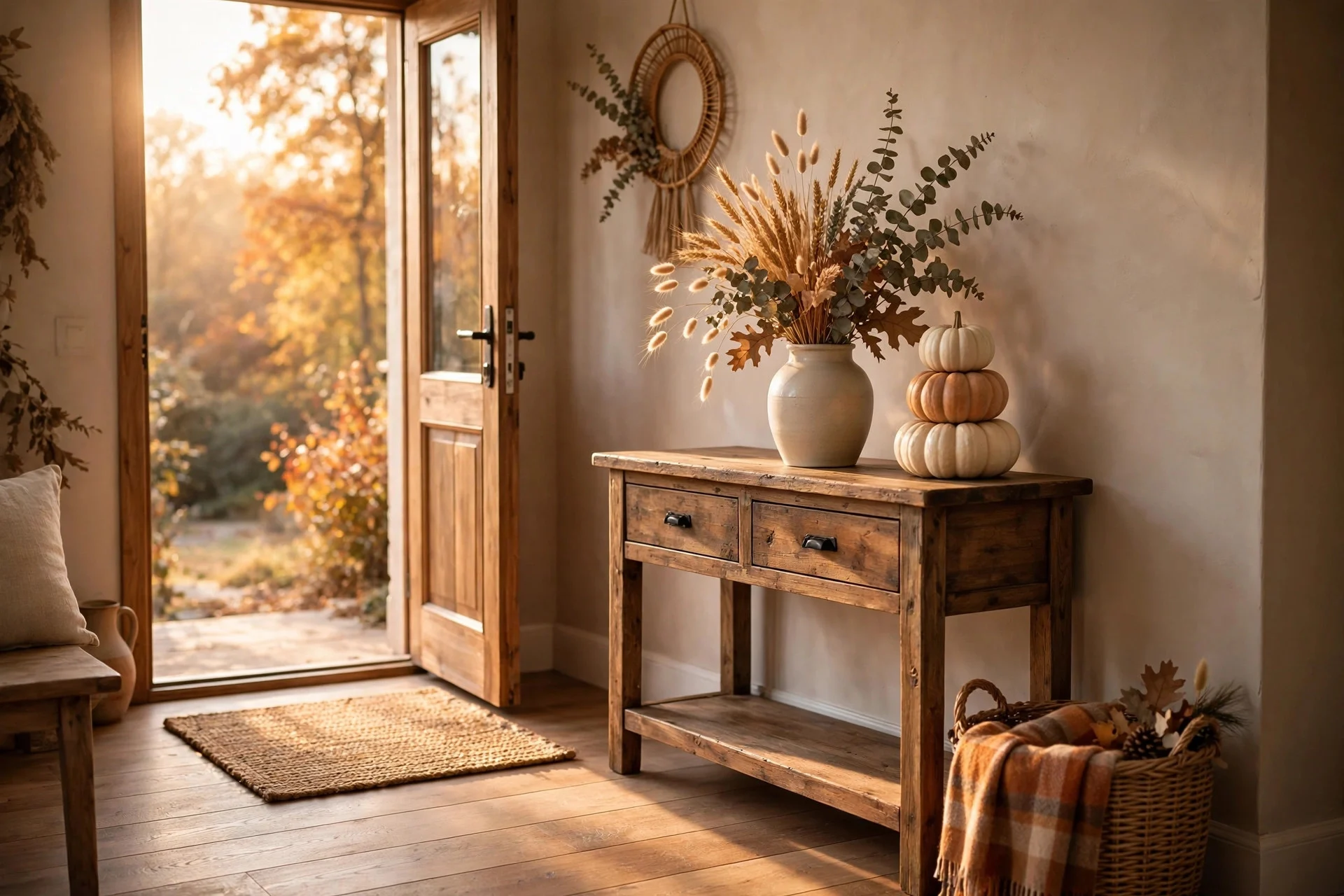
The entryway comes next, and it takes about fifteen minutes. The console table gets a vase with dried wheat or eucalyptus — both will last the whole month without shedding too much — and a small stack of pumpkins or a bowl of pinecones underneath. That’s it. The entryway is a passage, not a room, so it should feel like a hint of what’s inside, not a second living room.
My mistake the first year was putting real pumpkins on the porch on November 1st. If your porch gets direct sun, a real pumpkin can start to collapse in about ten days. Now I buy the porch pumpkins in the second week of November, or I use the faux ones early and swap in real ones later. The wreath and the mums go up in week one; the pumpkins wait until week two.
Week Two (November 8–14): Living Room, Low and Slow

The second week of November is for the living room, and the key word is slow. This is the room where your family will actually sit for hours, so it should feel like a living room that happens to be dressed for Thanksgiving — not like a Thanksgiving display that happens to have a sofa in it.
I start with textiles, because they make the biggest difference for the least effort. The summer-weight throw pillows come off, and rust, cream, and deep green ones go on. A knitted throw goes over the arm of the sofa. If you have a lighter rug you can layer over the everyday one, this is the week to do it. None of this is perishable, so there’s no rush — and honestly, doing it in week two means the room settles in and starts to feel like itself before the holiday arrives.
Then the coffee table and the shelves. A low wooden tray with a few small pumpkins, some dried leaves, and a candle is enough for the coffee table — low, so it doesn’t block anyone’s view across the room, and grouped together, so it reads as one arrangement instead of five small things scattered around. On the shelves, I swap in one or two fall pieces per shelf and leave the rest alone. The mistake I used to make was filling every shelf; the room looked cluttered, and by Thanksgiving I was tired of looking at it.
The mantel can start now too, but only the dry parts: the garland base, the candle holders, the stack of books with a small pumpkin on top. Leave the fresh greenery and any real fruit for the final days. A mantel that is finished too early has a way of looking stale by the time guests arrive, and a mantel that is half done looks like a project in progress, which is exactly what it is.
The Weekend Before: Dining Room and the Table
The weekend before Thanksgiving — the Saturday and Sunday before the holiday — is dining room weekend. This is the room that matters most on the day, and it’s also the room where early decorating backfires hardest, because a table that has been set for a week collects dust, and a centrepiece that has been sitting out for a week looks it.
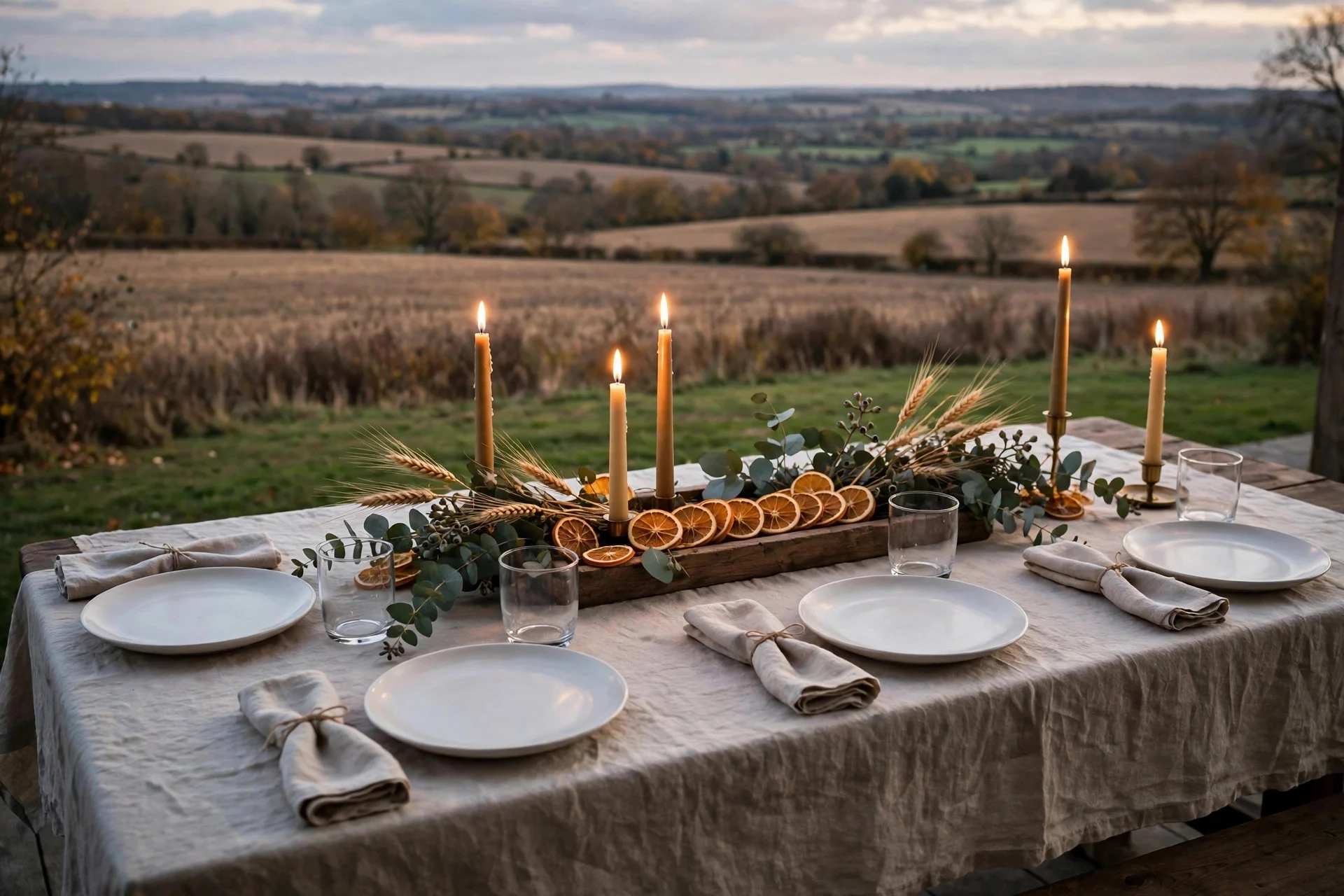
Here’s the order that works for me. First, the room itself: the tablecloth gets washed and pressed, the chairs get wiped down, and I check that I actually have enough plates and glasses for everyone coming. There is nothing worse than discovering on Thanksgiving morning that you’re two plates short. Second, the centrepiece — and this is the part worth taking your time over, because it’s what everyone will be looking at for two hours. A low arrangement of dried orange slices, wheat, and eucalyptus costs almost nothing and looks like it came from a magazine; if you want the full method, my guide to Thanksgiving centerpieces you can make in under an hour walks through it step by step.
The table itself — the plates, the glasses, the napkins, the place cards — I set the night before, or at the very earliest, the morning of the day before. I used to set it the whole weekend ahead and felt very organised, until I realised I was eating every meal at the kitchen counter for three days because the dining table was a museum. Now the table stays usable until the last minute, and setting it becomes part of the excitement rather than a chore I did days ago and forgot about.
One honest tip: if you’re short on time or money, the dining room is where to spend both. A beautiful table forgives a plain living room. The reverse is not true. My guide to Thanksgiving table decor that costs almost nothing is the one I’d read first if the budget is tight this year.
The Final 48 Hours: Kitchen and the Last Touches
The kitchen is last, and deliberately so. It’s a working room on Thanksgiving week — the busiest room in the house — and decorating it too early just means your decorations get in the way of the cooking, get splashed, or get moved to a random corner and forgotten.
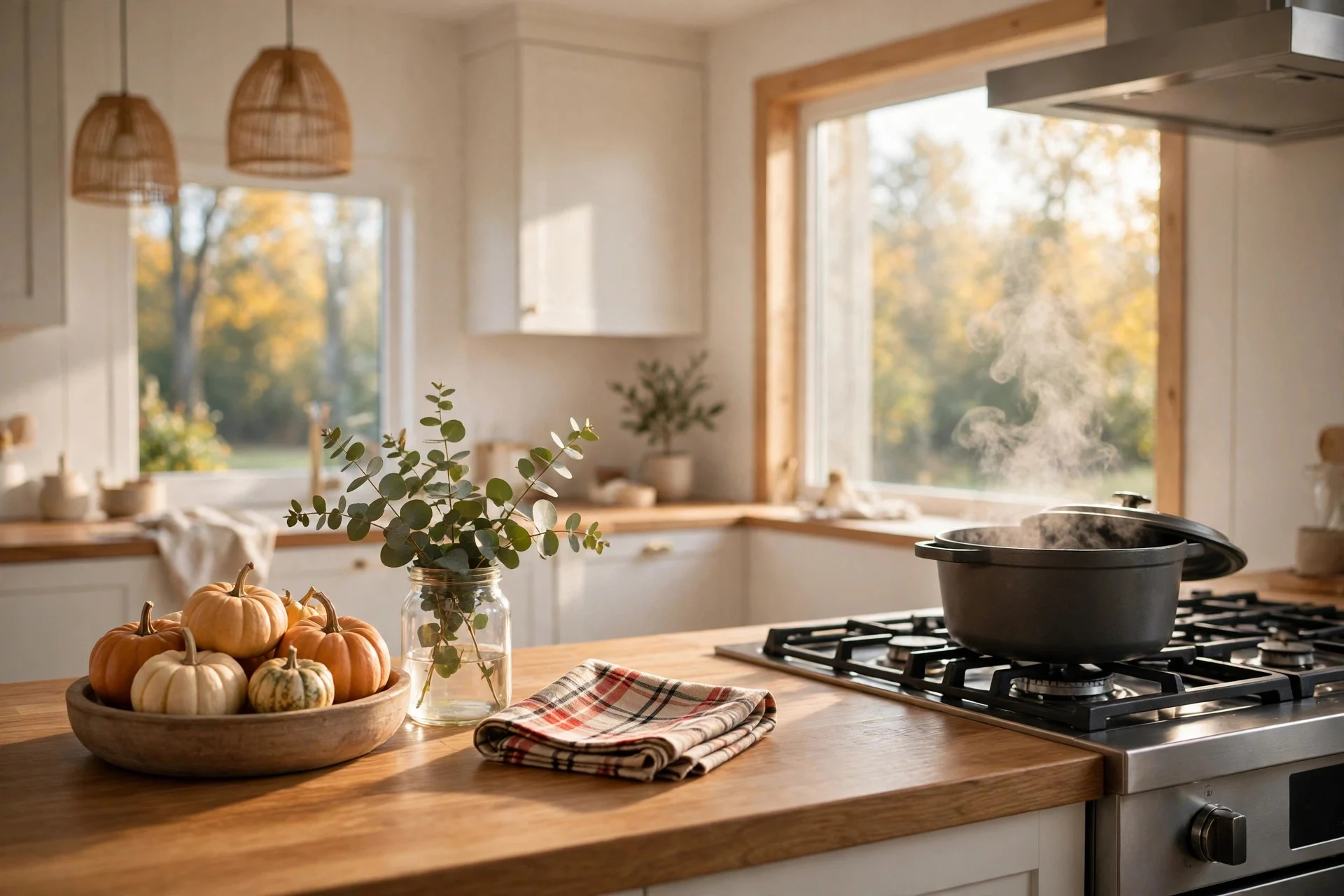
Forty-eight hours before the meal, I do the kitchen in about twenty minutes. A bowl of small pumpkins goes on the counter — the ones too small for the porch and too cute to waste. A sprig of eucalyptus goes in a glass jar by the sink. A plaid tea towel replaces the everyday one, and a candle goes on the windowsill. That’s the whole job. The kitchen should smell like cooking on Thanksgiving, not like a candle shop, so I keep the scented candles out of here entirely.
The final 48 hours is also when the fresh things go up everywhere else. Fresh greenery gets tucked into the mantel garland. The real pumpkins go on the porch, replacing the faux ones if you used them. The fruit bowl gets filled. If you bought flowers for the table, they go into water now, not a week ago — a week-old bouquet on Thanksgiving day is just a reminder that you bought it too early.
I keep a small box by the door for the last-minute things: the extra napkins, the place cards, the candle lighter, the matches. Everything I know I’ll need in the final hour goes in the box during the final 48 hours, so I’m not hunting through drawers while the turkey rests. It’s a small trick, but it’s the one that has saved me the most stress, two years running.
What I Leave Until the Day Of
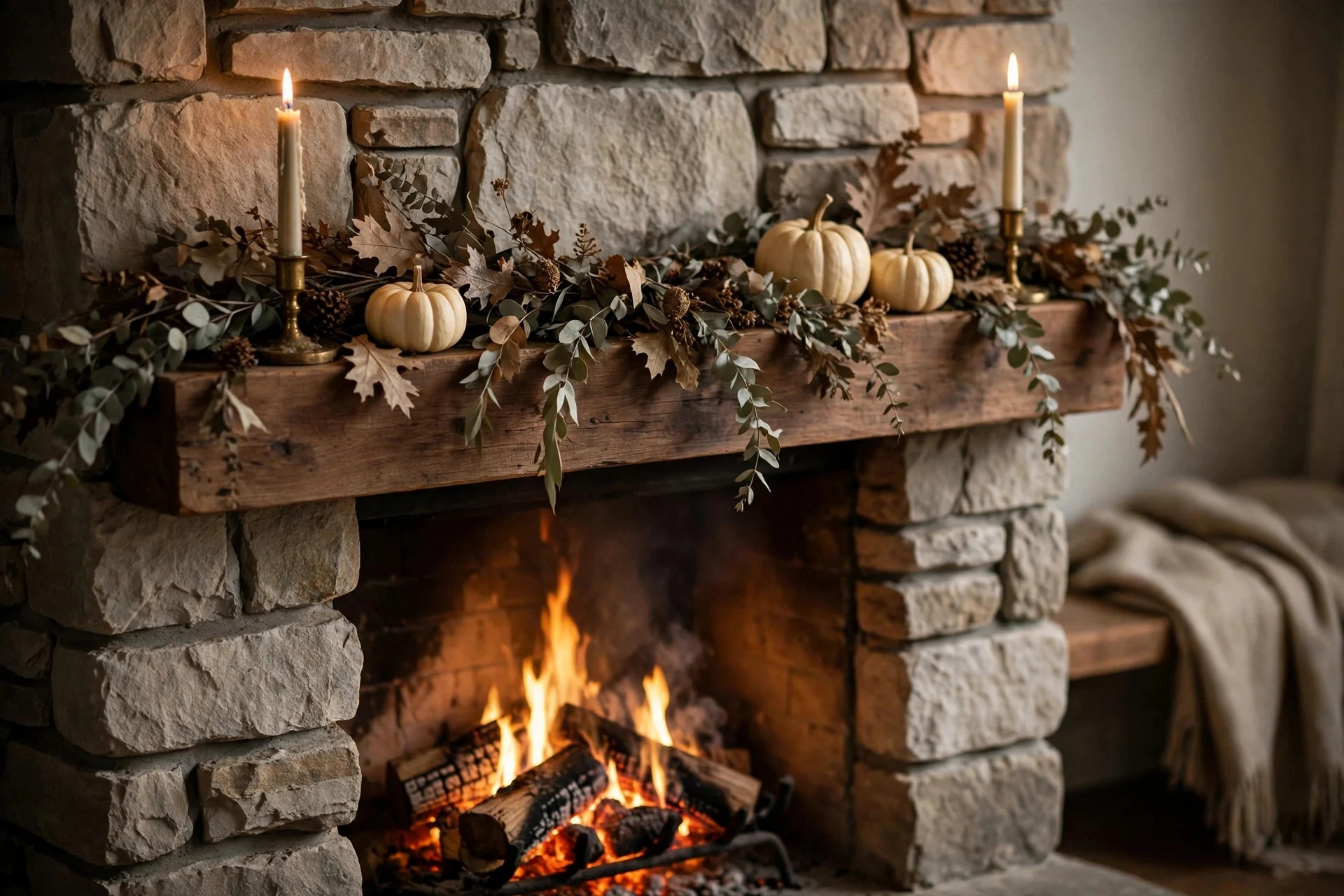
Some things only go up on Thanksgiving morning, and they’re the things that make the house feel alive rather than decorated. The taper candles on the mantel get lit — not before, because a candle that has been burning for a week is half gone and the wax is everywhere. The fresh herbs go on the table. The playlist goes on. The fire gets lit if the weather allows it.
The day-of list is short on purpose. Light the candles. Put the flowers on the table. Set out the appetisers. Open the front door for a minute and let the cold air in — the house always smells better for it. Then stop. The decorating is done, and the best thing you can do now is stop fiddling with it. Every year, someone in my family moves a pumpkin three inches to the left five minutes before guests arrive, and every year, nobody notices except the person who moved it.
If you like the natural, dried-and-gathered look on the table — the oranges, the wheat, the eucalyptus — my guide to the natural Thanksgiving formula is the whole method in one place, and it comes together in about four minutes on the morning itself. That is the right speed for Thanksgiving day: four minutes of decorating, then the rest of the day is for cooking and people.
The Mistakes I Made So You Don’t Have To
The biggest mistake was treating decorating as one job with one date. November 1st, everything up; or the night before, everything up. Both versions made the holiday worse. The house either looked tired by the day itself, or I was too tired to enjoy it. The room-by-room timeline fixed both problems at once, and it did something I didn’t expect: it spread the cost out too. Buying a little each week is easier than buying everything in one panicked trip.
The second mistake was buying fresh things too early. Real pumpkins in direct sun, fresh greenery in a warm room, flowers bought a week ahead — all of them punish you for enthusiasm. Fresh things go up in the final 48 hours, or on the day. Everything else can wait its turn.
And the third mistake was decorating rooms nobody uses. The guest bedroom, the home office, the hallway upstairs — I decorated them all the first year, and not one guest ever saw them. Now I decorate the rooms where Thanksgiving actually happens, and I let the rest of the house be itself. It turns out nobody has ever said, “Lovely dinner, shame about the undecorated hallway.”
Start with the porch in week one. Let the living room follow in week two. Save the dining room for the weekend before, the kitchen for the final 48 hours, and the candles for the morning itself. That’s the whole timeline — and if you follow it, Thanksgiving week feels like a slow build toward something good, instead of a single frantic day you have to recover from.